
Without trust you can't live. It's "the" basic element in politics, business, management, friendship, love and life.

Now, trust is not an easy subject.
For example:
What is Trust?
There can be no trust unless you give it first.
And even with someone you fully trust, you'll have to cope with distrust.
If you think you won't.. Just the fact you consciously decided to trust someone, means that you implicitly considered the theoretical possibility that he or she could betray your trust. So distrust was on your table. Not considering distrust is naive or even risky and will in most cases end in a disappointment.
Let's look at some properties of these trust relationships:
Trust relationships:
Trust relationships are also two dimensional:
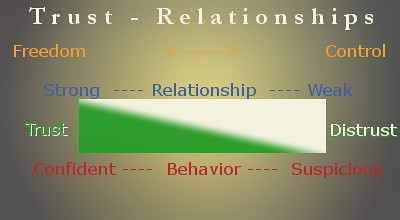
Let's look at how you can manage trust and distrust in the same relationship.
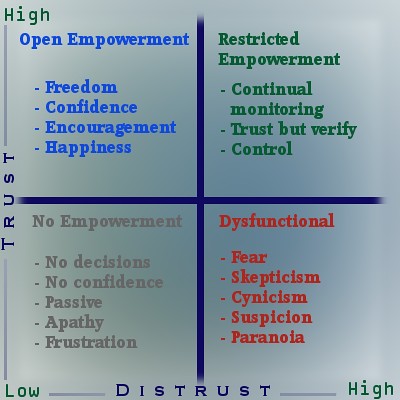
From this matrix we may conclude the next rules of thumb:
That's not all folks! It's just the start. Trust me.
Now, trust is not an easy subject.
For example:
- Research showed that women and men both lie about three times every 15 minutes in a simple conversation.
- The average credibility of a CEO in western countries is below 30%.
- Only just 40% finds it (very) easy to trust an accountant.
There can be no trust unless you give it first.
And even with someone you fully trust, you'll have to cope with distrust.
If you think you won't.. Just the fact you consciously decided to trust someone, means that you implicitly considered the theoretical possibility that he or she could betray your trust. So distrust was on your table. Not considering distrust is naive or even risky and will in most cases end in a disappointment.
Let's look at some properties of these trust relationships:
Trust relationships:
- are bipolar : Trust and Distrust
- include ambivalence: Degrees of [dis]trust, Simultaneous trust and distrust
- are multifaceted: We can both trust and distrust the same person in different contexts
Trust relationships are also two dimensional:
Let's look at how you can manage trust and distrust in the same relationship.
From this matrix we may conclude the next rules of thumb:
- 'Just' managing distrust, won't bring more trust.
- If there is not enough trust, trying to manage distrust will escalate and lead to apathy and frustration. Once you're in this position, your relationship gets 'locked' and the both of you won't be able to manage your trust anymore.
- Always start managing trust first.
In a situation with "low distrust" by giving 'more freedom', 'stimulating each other' and 'creating happy moments'.
In a situation with "high distrust" first by 'creating rules' and 'agreements' and (re)gain confidence in each other.
That's not all folks! It's just the start. Trust me.


