Tuesday, July 24, 2012

Best Choice

In real life you often have to take a decision in a situation were you have to pick out "the best" opportunity out of "n" possibilities in a situation were you (ex ante) do not know much about what you can expect in terms of quality or quantity.

For example:

  • Making the right investment
    You want to make an investment today. From your stockbroker you get each day about 20 opportunities to invest. But you want to make only one investment this day and it should be the best one. How can you be sure to pick the right one?
    You have only limited time (say about 10 minutes) for each investment to decide; after that, you’ll have to wait for the next offer.
     
  • Choosing the best candidate for the job
    You’re the personnel-manager of a certain company. You make a deal with your external HRM-advisor that he will deliver you this month 10 potential candidates for the vacancy you have. After each candidate you have to decide wetter you accept him or wetter you go one for a possible better candidate. You want the best candidate. What can you do?
     
  • Applying for the best job
    You solicited for a new job. Six companies have given you an invitation for a visit. After each visit you are obliged to say wetter you take the job or don’t. You want the best Job. What is wise to do?
     
  • Buying a new car
    You want to buy a new car. Although the price of that car is fixed, every dealer gives a quick-decision discount.
    You decide to visit 7 dealers. After each visit you have to decide wetter you "buy" or "let go" (the dealer wont accept that you come back later after you came to the conclusion that he was after all the cheapest).
    You want the highest discount; How can you manage?
     

In each of these cases you can ask yourself: what is the optimal strategy? Take the first opportunity or wait until the last? Skipping the first 2 opportunities and than take the next one that is better?

In literature (management science) these kind of problems are known as "Best Choice Problems" (BCP's). BCP's are packaged in descriptions like "The Sultan's Dowry Problem" or "The Secretary Problem".

BCP's are characterised by the following assumptions:

  • You want "the best" choice out of "n" possibilities
  • You handle each opportunity after another. After each opportunity you have to decide wetter you take the offer or go further (you can’t go back and take an earlier opportunity after all).
  • You don’t have enough knowledge about the group of "n" possibilities self (in terms of quality or quantity)


Solution

The best strategy in these kind of cases is to wait (don’t choose) until the first "m" possibilities of the total number of opportunities "n" have passed. After these "m" possibilities you accept the first offer that is "better" than the one you’ve had until the moment of decision. The word "better" stands for "better candidate", "better financial offer", etc.

If you’re interested in the mathematical theory behind this kind of problems, click on one of the links below:


Best Choice Calculator

The Best Choice Calculator calculates the optimal number of possibilities that you have to let pass [m] before taking the best one thereafter, to achieve the maximum probability [P] that you indeed will realise the best choice from a given total number of possibilities [n]. Try it out!

  • The first column returns "m"
  • The second column returns "P"
  • The input-variable "n" is the total number of possibilities
Total number of possibilities [n] =  
   [m]       [P]


Rule of thumb

As you perhaps noticed in using The Best Choice Calculator, there is a close relation between the number op possibilities [n] and the number of opportunities you had to skip [m].

When we have to take decisions in "real life", we do not (yet) have a build-in computer-chip in our head to calculate for each [n] the corresponding value [m]. But don’t worry, all you have to do is to memorise the next rule of thumb:

Rule of Thumb

Number of possibilities

Number of possibilities to skip  = 

3

Or, in plain mathematics:

n

m  = 

3

Of course the rule of thumb is an approximation.
In the next table you see how [n] and [m] are exactly related for values of n from n=1 to n=

Although it’s nice to have a "rule of thumb", don’t forget to decide on your gutfeeling as well.

Mixing intuition, experience and rules of thumb, guarantees the ultimate best choice.

J.N. Berkemeijer / July 2002
Free to copy  Making Decisions

Saturday, October 15, 2011

What you see is true

If your colleague, friend or relative disagrees with you, how do you respond?

Your reality
When we view or perceive (hear, smell, taste) something, this is reality to us.
And indeed it is a kind of reality, your reality! As, given your 'filters' like genes, education, physical (health) condition, background, position, circumstances, consciousness, and experiences (etc....), every human being can only perceive a small and often different glimpse of what reality really is.

So, to put it in an other way:


What you see is true, but what others see too!


Consequences
This implies that instead of trying to convince the other that your point of view is right, it's more constructive and fruitful to ask the other about his view and opinion.

At first it will be difficult to understand the other and perhaps it even arouses aversion, but eventually you'll be able to better understand the other's point of view without the obligation that it necessarily has to become your point of view.

This way you'll be able to enrich, grow and develop yourself to a more complete human being. This way of thinking opens new doors and gives space for new solutions and breakthroughs in a growing controversial world.

Friday, September 9, 2011

Risk Perception

Risk is all about perception, as the next story illustrates...

Finally you arrive at your hotel late that night....   The hotel manager has only two rooms left. These two rooms are exactly the same, except for one aspect: The fire alarm.....

The manager tells you that in the event of a nighttime fire due to the usual causes, guests in Room 1, equipped with Alarm 1, have a  2% chance of dying. Guests in Room 2, equipped with Alarm 2, have only a 1% chance of dying.

However - things in life are always complicated -  there's a slight problem.....

According to the manager...... The wiring of Alarm 2 is such that it sometimes causes electrical fires that increase the risk of dying in a nighttime fire by an additional 0.01%.

In other words, Alarm 1 is associated with a 2% risk of death and Alarm 2 is associated with a 1% + 0.01% (betrayal) risk of death.

What room do you choose?

Outcome
According to a study by Gershoff and Koehler, most participants choose the room with Alarm 1. This,  even though this room 1 has double the increased risk of fire death. Reason: most participants found the tiny risk of "betrayal" (product malfunction) much more frightening than the much larger risk of actually dying.  When people get upset by a tiny risk, they often paradoxically choose the much larger risk.

Personally I think a more imaginable risk 'weighs' stronger than a non-specific abstract risk......

Conclusion
This simple example proofs that perception or emotion has a strong influence on risk decisions.

Next time you have to make a decision on risk, try to make a rational guess. Than, act on this calculated guess and not on your 'risk feeling'.
Nevertheless, keep in mind 'risk decisions' are often irrational, no matter how strong you prove that they are not. It seems we have to live with the fact that, regarding risk, we're all victim of the same emotional bias....

Read more about this interesting subject on:

- Vaccination and betrayal aversion (2011)
- Safety First? The Role of Emotion in Safety Product Betrayal Aversion (2011)

Friday, July 1, 2011

The Risk of bicycling

You decided to start a 3 year math study at City University in London. From your brand new apartment in Southall, it's a 12.5 mile drive to the University at Southhampton Street.  As a passionate cyclist you consider the risk of cycling through London for the next three years.

Based on your googled " DFT's Reported Road Casualties 2009" research (resulting in a cycling death rate of 36 per billion vehicle miles), you first conclude that the probability of getting killed in a cycle accident during your three year study is relatively low : 0.1% (≈ 3[years] × 365[days] × 25[miles] × (36 [Killed]  ÷ 109[vehicle miles]).

Subjective probability
After this factfinding you start to realize it's YOU getting on the bike and it's YOUR 0.1% risk of DYING  in the next three years of your study....

Hmmmm...this comes closer; it makes things a little different, doesn't it? 

Its looks like 'subjective probability' - on reflection - is perhaps somewhat different from 'objective probability'.

While your left and right brain are still in a dormant paradoxical state of confusion, your left (logical) brain already starts to cope with the needs of the right (emotional) half that wants you on that bike at all costs!

Russian Roulette
Now your left brain tells you not to get emotional, after all it is 'only' an additional 0.1% risk. Already your left brain starts searching for reference material to legitimate the decision you're about to take.

Aha!.... Let's compare it with 'Russian Roulette', your left brain suggests. Instead of 6 chambers we have thousand chambers with one bullet. Heeee, that makes sense, you talk to yourself.

With such a 1000 chambers Russian gun against my head I would pull the trigger  without hesitating....  Or wouldn't I?..... No.., to be completely honest, 'I wouldn't risk it', my right brain tells me.

Hé... my left brain now tells me my right brain is inconsistent: It wants me on the bike but not to take part in a equal 'death probability game' of Russian roulette. Why not?

In Control
My left half concludes it must be the 'feeling' of my right side that makes me feel I'm 'in control' on my bike, but not in case of Russian Roulette. That makes sense, tells my left brain me. Of course! Problem solved! My right and left brain finally agree: It's only a small risk and it's I who can control the outcome of a healthy drive.  Besides, this way the health benefits of cycling massively outweigh the risks as well, my right brain convinces me superfluous.


A final check by my right brain tells me: If I can't trust myself, who can I?
This rhetorical question is the smashing argument in stepping on the bike and to enjoy a wonderful ride through London City.
As ever...,


Aftermathematics
After returning from my accidentless bike trip, I enjoy a drink with a colleague of mine, the  famous actuary Will Strike  [who doesn't know him? ;-)].


After telling him my 'bike decision story' he friendly criticizes me for my non-professional approach in this private decision problem. Will tells me that I should not only have analyzed the probability (P), but also the Impact (I) of my decision. Remember the equation: Risk=P×I?

Yes of course, Will is right. How could I forget? ..., the probability of getting a deathly accident was only 0.1%.

Yet, 'when' a car hits you full, the probability of meeting St. Petrus at heaven's gate is 100% and the Impact (I) is maximal (I=1; you're dead ...)

Summarized:

Risk[death on bike;25 miles/day; 3 years] =
Probability × Impact = 0.1% × 1=0.1%
From this outcome it's clear that, even though the Impact is maximal (1=100%) , on a '0% to 100% Risk scale' this 3 year 'London-Bike Risk Project' seems negligible and by no means a risk that would urge my full attention.

I'm finally relieved... it always makes a case stronger to have a taken decision verified by another method. In this case the Risk=P×I method confirmed my decision taken on basis of my left-right brain discussion.  Pff....

Afteraftermath
The next morning, after my subconscious brain washed the 'bike dishes' of the day before, I wake up with new insights. Suddenly I realize I tried to take my biking decision on the wrong variable: Probability, instead of Impact.

Actually, in both cases and without realizing, I took my decision finally on basis of the Impact and the possible 'Preventional Control' (not damage control !!!) I  could exert before and during my bike trip.

I had to conclude that in cases of high Impact (I>0.9), nor my left-right brain chat, nor the 'Risk=PxI' formula lead to a sound decision, because both are too much based on probability instead of Impact. In other words:

In case of high Impact, probability is irrelevant


In case of high Impact, only control counts


From now on this 'bike conclusion' will be engraved in my memory and I will apply it in my professional work as well.


P.S. for disbelievers, the tough ones!
If you're convinced you would take the risk of firing the 1000 chamber  Russian gun against your head, you probably valuate the fun of the bicycle trip higher than probability of the loss of your life or good health.

In this case, suppose someone would offer you an amount of money if you would take part in a 1000 chamber Russian roulette instead of a bicycle tour. At which amount would you settle?

Let's assume you would settle at € 10.000.000 (I wouldn't settle for less). In this case you really value your bicycle trip!!!! 

Interested? read more at Actuary-Info

Friday, March 4, 2011

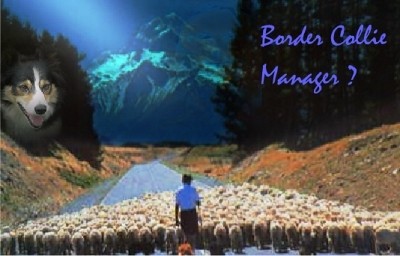
Are you a B.C. Manager ?

Yes.... Are you a B.C. Manager ?
No this is not about whether you have a 'Before Christ Managementstyle'.....
The question actually is:


Are you a Border Collie Manager ?


But seriously now.. let's start with...

What is a Border Collie?
A Border Collie is a special kind of dog, trained to herd sheep.
The herding instinct of Border Collies is in fact the original killing instinct of a wolf that - over the past two hundred years - has been toned down through selective breeding. Border Collies circle the livestock at the far end and bring it back to the handler.

How do Border collies manage?
Border Collies tend:
  • not to use force (initially) to drive the livestock where they want to
  • use what is known as "eye", a sort of threatening stare-down that intimidates the stock into moving in the desired direction
  • If the non-physical means of moving stock doesn't work, his natural instinct is to slowly escalate the encounter into an ever-increasing use of force.
  • Barking, nipping, and eventually gripping (biting) are used to get the point across to the more stubborn sheep.

Comparison
Now let's translate this behavior into a management environment.
Think of yourself in the position of a CEO who has to manage his managers (border collies) in the managementteam.
Your managers have 'to deal' with your employers (with all respect: the sheep in this example).

Now, please think about the next considerations:
  • Would you like your managers to operate like border collies
    At first site it may look like your managers don't have their own opinion. They act on your whistle. But looking closer, managers - like border collies - have a clear goal, make their own decisions and act as a coherent team without mutual competition to achieve their goal.

  • Would you like your employees to be treated like sheep by your managers?
    Of course you wouldn't! Your employees are the key factors in achieving the success of the company. And looking closer, your managers - like border collies - treat your employees (the sheep) intentionally with dignity en gradually build an adequate approach for each employee. So each employee (sheep) has the possibility to learn and develop itself.

Of course, every comparison (this one too) has its limits.In practice you'ld probably some of your best "sheep" to operate as border collies too. You as the CEO of the company are responsible for the Corporate Teambuilding
of you border collies.

The principals of border collie management are trained by TLC according to the next two managementprinciples


TLC Management Principles


Body Language and the Boardroom
You don’t have to be a mountaineer or orienteer to learn about team spirit, body language and leadership skills. In fact you don’t need to run, climb, or engage in any strenuous exercise. Sheepdogs are excellent teachers of patience, understanding, tolerance and teamwork. They have their own form of ‘language,’ and learning the communication skills of a ‘thinking dog’ is fascinating.


TLC - Think Like Canines
Dogs in a pack work together in harmony for the good of the pack. They don’t argue about their position, they accept and respect leadership but use their initiative whenever the need arises.

For years shepherds and their dogs have worked together, neither one afraid to take responsibility, to delegate or to question a decision that could ultimately save time and energy. Is it any wonder that the humble sheepdog is proving invaluable as a role model for the corporate world?

From the managing director to the tea maker everyone is important and everyone is part of a team.


You, as a CEO Super Border Collie of course handle this process with dignity and respect. Be conscious, be a border collie manager if the situation demands to be one.

Links:
- TLC : Thinking Like Canines
- The Ten Management Principles of Supercommunity Banking

Monday, November 1, 2010

IF

One of the best inspirational poems ever written, is 'IF' , by Rudyard Kipling (1895):


So..., 'If' you ever feel down or depressed, take up this poem, read it again and feel the energy coming back into your blood vessels....

Word Empowerment
This empowerment by words is also visible when a text, document or url is translated into Word-Picture. A wonderful application called Wordle, helps you to build these word-clouds.

Here is a Wordle example from Kipling's poem IF:

Enjoy the IFs in your life!

Friday, April 30, 2010

Are you the boss

What does it takes to be the boss?


The Parrot

One day a man goes to a parrot shop to buy a parrot. The assistant takes the man to the special parrots section and asks the man to choose one.

The man asks, ''How much is the one on the right?''
The assistant says, 'a $ 100.'' The man is surprised and asks the assistant why this parrot is so expensive. The assistant explains, 'This parrot is very special. He whistles and sings'

'What about the other two the left?' the man asks.
The assistant says, 'They costs $ 200 a piece, because they also speak, answer incoming telephone calls and takes notes.'

'What about the gray one in the middle?' the man asks.
The assistant says, 'That one's $900 !'
The man says, ''What does HE do?''

The assistant says, 'I don't know, but the other parrots call him boss.'


Sunday, February 21, 2010

Powerpoint Mortality

Whether you're an accountant, consultant, student or salesman, when we take up a new challenging project, we're inclined to spend most of our time on data mining, modeling, reconsidering, detailing, arguing, making things perfect and finally, drawing the conclusions and writing the exhaustive proposal report....

Fortunately - in this case - your right on schedule! You've got exactly one day left before your Board presentation of the project. Still completely in a rush and overexcited about the stunning results of your successful investigation, you start up your laptop to wrap up your proposal report in a full flash Powerpoint presentation.

That night at 01.00 AM, you successfully finish your ppt presentation. Just in time! Completely satisfied about this phenomenal achievement, you e-mail the ppt to Nosica, the Board's secretary you know well. She, as well as the Board, will be impressed by your 'night shift work'. Who said you were doing a 9 to 5 job?

The next day, at 14.00 AM you enter the Board room, full of confidence. Your presentation is start-ready, the beamer glows, you're fully concentrated on your audience and in a 'cashing' flow....

After 20 minutes of presentation, including your ten recommended practices and some questions, you leave the 26th floor. All went well...
Time for a drink and a well earned good night sleep...

Next morning, 09.00 AM, the Board's secretary replacement calls you: Your proposal has been declined....

You're flabbergasted, how could this happen? After all this work you've been through.

What went wrong?

The answer is simple, you denied Wayne Burggraff's Law of Presentation:

"It takes one hour of preparation for each minute of presentation time."

So next time, in case of a 20 minutes presentation, invest 20 hours of your time in research, development, organizing, outlining, fleshing out, and rehearsing your presentation.
In essence: if you fail to prepare well, you are well prepared to fail.

Tips.....
Here are some practical tips that might help you with your preparation:
  1. Ask yourself: ''If I had only sixty seconds on the stage, what would I absolutely have to say to get my message across."
    -- Jeff Dewar --
  2. The simplest way to customize is to phone members of the audience in advance and ask them what they expect from your session and why they expect it. Then use their quotes throughout your presentation."
    -- Alan Pease --
  3. No one can remember more than three points.
    -- Philip Crosby --

Fear of presentation
It's surprising to see that people are more afraid (41%) of 'speaking to a group' than of death (19%).
Now it's clear why we search the help of Powerpoint to 'survive' on stage.

Powerpoint Mortality
We all know Powerpoint..... Powerpoint itself is not good or bad, it's the way you use it.

The mortality rate of Powerpoint is humorously demonstrated by Don McMillan:


Who Needs Powerpoint?

Last January I was heading for a presentation with the help of Powerpoint. Full house. However, on the supreme moment the local beamer gave up. I simply decided to bring my message in an interactive session with my audience, without the help of Powerpoint.

Yes, it was different, challenging and even fun! Because of my thorough preparation - I was able to concentrate on almost everyone of my audience. So...., another Maggid's tip could be:

Prepare your presentation without Powerpoint!

A presentation try out
In the mid nineties my employer's company was heading to get listed at the stock exchange. I remember I had to give a presentation before a panel of 70 international analysts, who would probably raise all kind of difficult questions. In order to prepare 'abap', I called my strategy director as well as my CFO and asked them to act as my 'try out analysts audience'.

I told my colleagues I would give the presentation three times in a row. In the first two presentations they were obliged to interrupt me as much as possible, to raise difficult or weird questions and to put me to test (keeping my humor and concentration). During the third presentation they had to act as normal audience.

To make a long story short: after three presentations, my two colleagues kept their breath in combination with a desperate look in their eyes. I told them not to worry and reassured them my presentation at the analyst session would be successful.

And so it was, as I was fully prepared on every possible question and didn't had the need to look at my ppt presentation, I could fully focus on my audience. Lesson: Make the preparation tough, you'll benefit from it in the final presentation.

The powerpoint master
Yes, there are a lot of rules, regarding the use of Powerpoint.
The Golden Rule is that all PowerPoint presentation rules, principles, and guidelines are just secondary to doing what is ultimately right for your audience. Critical point is, you can only break the presentation rules if you know them .

It's just like in other sciences, once you've become a master, the real art of your profession is not anymore in applying equations and methods 'by the book'. Now it comes down to break the existing rules and conventions in a such a professional way, that new problems and social challenges are being (re)solved in a different way. Key point here is that not only your professional skills have to be outrageous, but your presentation skills as well. As the success of a good peace of master craftsmanship, is completely dependent on the way it is presented.

Mindmapping
Let's conclude with some practical free(ware) presentation tip.
Although you're probably aware not to overuse clip art, it's good practice to set up your presentation in a consistent and well polished style.

Of course you can use expensive business packages to illustrate your presentations, but there's also an excellent freeware application called: EDraw Mindmap 4

With the help of Edraw, creating presentations and mind-mapping is a question of minutes.

Enjoy preparing and giving presentations, learn to be(come) yourself on stage and overcome any possible fear of speaking to groups......

Related links:
- EDraw Mindmap 4 (Completely freeware!)
- EDraw Mind Map 1.0
- Edraw Max (not freeware)
- Lovelycharts (free, one application; online)
- Presentation skills (youtube)
- The New Office Math (youtube;Don McMillan )
- Presentation skills (ppt)