Saturday, January 2, 2010

Bumblebee Feedback

We all know those plump Bumblebees that fly around. Until now scientists have been unable to develop a sound theory on how Bumblebees fly. Traditional aerodynamic theories (e.g. theories that explain how airplanes fly) are inadequate to explain the lift or fast forward flight of a Bumblebee. Yet, Bumblebees fly!


Clue
Although it's hard to fit into mathematical formulas, scientist have a clue on how insects, Bumblebees in particular, are able to fly.

Contrary to an airplane, insects are flapping their wings.
Bees beat their wings approximately 200 times a second (video), which is 10–20 times as fast as nerve impulses can fire. They achieve this because their thorax muscles do not expand and contract on each nerve firing, but rather vibrate like a plucked rubber band.

The clue can be found in the way insects flap their wings. The flapping motion causes the leading edge vortex to spiral out to the wingtip, siphoning off the vortex and delaying stall. One way or the other, the augmented lift, coupled with the delayed stall, is the principle mechanism that insects use for generating 'lift'.

Until this very moment (2009) we are unable to explain the exact principles behind this complex lift effect. Perhaps there isn't a single simple theory and is the only 'explanation' found in a process called 'Feedback Dynamics'.


Feedback Dynamics
In the world of Feedback Dynamics we adapt and adjust 'our' behavior - without any conscious handling or direct nerve interference - in small rapid steps until the desired goal (e.g. 'lift') has been attained.

Feedback Dynamics doesn't ask 'how' or 'why'.

Counting in the dynamic influence of the continuously changing environment, Feedback Dynamics simply persistently adjusts behavior in the direction of the defined goal (e.g. I want to fly).

What can we learn from the Bumblebee?
Our bumblebee lessons could be summarized as follows:

  • Logic & Science
    Even if you think you don't qualify or are unable to achieve things in life because 'logic' tells you so, the doctor (specialist) has told you or your family tells you you can't: Don't accept this 'science' for an answer. Find new ways to achieve your goals, show your environment it can be done, although perhaps in a different way.

  • Stop How & Why?
    If you want to achieve extraordinary new results and you found out they couldn't be achieved 'the normal way', don't count anymore on your history of 'how' and 'why', but trust on your gut-feeling. Take a few small steps in a arbitrary direction and see if you can get away from your current position. This - strange at it might seem - preferably isn't necessarily in the direction of your predefined goal. From this new achieved position, repeat small steps again. Enjoy the journey and soon you'll learn to discovered Nova Terra or have learned to fly.

  • Math Models
    Most things in life can't be fully explained by mathematical models. A math model helps to explain to describe reality. It is, at its best, a simplified projection of reality, but must not be confused with reality itself.

  • Flap your wings
    If you get stuck in life, never sit down in despair too long, but flap your wings: Take action!

  • Believe in yourself
    Like the Bumblebee, always keep believing in yourself. Never (unhealthy) doubt yourself or don't ever let anybody bring you down who can 'proof' you can't fly or tells you that you aren't good in 'this' or 'that'. You don't need proof, you Are the proof. Even if you're now and then wrong, that doesn't mean you're totally wrong. It shows you're human. Try to learn from it (if possible) and in any case don't give up on yourself!

Enjoy life and apply Feedback Dynamics in it!

Sources:
- Dissecting Insect Flight (2005)
- Mechanics of Forward Flight of Bumblebees (1989)
- Control Theory: Design and Analysis of Feedback Systems
- Wikipedia
- Why bumblebees can fly

Wednesday, December 30, 2009

The Golden Rule


At the end of 2009 I would like to quote 'Unexamined Assumptions', a subpart of a chapter called Falsity, from the interesting on-line book :


A Logical Argument in Support of a Rational Basis for Community including Necessary and Sufficient Conditions for Sustainable Happiness for All Sentient Beings in a Hypothetical World

1989 - 2007 , by Thomas L Wayburn

Unexamined Assumptions
We think we know almost everything; what we actually know is almost nothing – and most of that is false. The most pernicious type of ignorance is belief in falsehood. We are ignorant, but our minds are filled with something.

In the beginning, our minds begin to be filled by words, which represent ideas. Next, our minds begin to be filled with notions, i.e., unexamined assumptions, promulgated or inculcated by parents, teachers, government, business, etc. Some of these notions we hear repeated everyday, but others are buried so deeply that never are we aware of their existence. In either case they are prejudices, by definition, since they have been assimilated without the exercise of judgment or reason, i.e., from Latin: prejudicium – before judgment. Some are true, but most are false.

Social institutions are willing to go to great lengths to prevent falsehood from being exposed. Heterodox views are everywhere repressed. The world stands on the brink of the Orwellian abyss.

People who are unwilling to examine their prejudices are said to be closed-minded. The notion that all fundamental philosophical questions have been answered is the ultimate mind closer. The world is filled with closed-minded people and most of them will never be influenced by appeals to reason, but that does not excuse any one of us as individuals from dragging out and examining under the cold light of reason even our most cherished prejudices.

The world may not be ready to give up its myths, but there is no law of the universe that says we cannot understand something merely because our ability to make a living depends on our not understanding it.

As soon as one of our assumptions is questioned or its opposite averred by even one solitary soul, it becomes incumbent upon us to drop the contested claim as an assumption and provide for it, instead, a proof. If the claim be metaphysical, it must be supported by reasonableness, aesthetics, and utility. That’s what I believe. None of us is completely open-minded. I am curious to know, however, why there is such a great disparity between what one can say to an individual and what one can say to the general public.

To summarize, we accept much falsehood for two important reasons:
  1. most of what we believe was learned before we were able to examine its reasonableness critically
  2. we are bombarded by lies every single day of our lives

Adding remarks: The Golden Rule
We've ended up in a society that is aware of itself, but unable to change it.

The awareness has created a 'happy schizophrenic' attitude on an individual level, often combined with an increasing lack or willingness to invest in each other or collective and social initiatives.

There is - without any guarantee- a way out. Live your life according to the principle

'Do unto others as you would have them do unto you'

Try to live up to this principle 'by heart' and not just because of fear. This principle is the leading principle, the Golden Rule, in most cultures, philosophies and religions [Christianity (Luke 6:31), Confucius (Analects 15:23), Buddhism (UdanaVarga 5:18) ], except for the Islam, as it is not mentioned in the Quran. However, a very restricted version of the principle of reciprocity can be found in Imam al-Nawawi's Forty Hadiths (Number 13) where the Golden Rule only applies only among "brother" Muslims.

Still the golden rule is a basic relativistic-logic ethic and one of the most universal moral codes known.

Anyhow, let's go for a better world and start with ourselves....

Sources:
- Ethics Of Reciprocity
- Versions of the Golden Rule in 21 world religions
- Where is the golden rule in the Quran?


Thursday, August 27, 2009

Route in Life

Do you also intent to follow the simplest, direct or easiest route in Life?
Right you are....
Going from A to B in life is like a risk management game.
As the captain of your Body&Mind-Ship (BMS) heading for a New Land at Port Novaya Zemlya, you'll have three starting issues:

Three starting issues
  1. Define your target (B): Know where you want to go in life
  2. Define your starting point (A): Know Where an Who you are in life
  3. Define your Route: Know How you want to go from A to B

In terms of risk management there are two main targets:

Main Risk Management Targets
  1. Long term Target
    Reach your final target (Novvaya Zemlya)
  2. Short term Target
    Avoid short time risks, tackle problems along the way (avoid ice floes)

So, what kind of approach is right for reaching your goal?
  • If you concentrate too much in life on your 'final goal' or you want to achieve your goals too fast or too direct, you'll certainly hit a short term problem, like an ice floe, and end up crashed as a hero or a martyr.
  • If you concentrate too much on the short term problems in your life, you'll loose sight on your final goal and certainly fail to reach Novaya Zemlya.

The solution of this paradox is (of course) to concentrate on the short term goals as well as keep an eye on the long term goal at the same time.

The optimal route?
But what is the best strategy for finding the optimal route in life?
Take a look at the next map to find out the best strategy for this ship.


Strategy I: Don't think, go to your target in a straight line
The most logical route from A to B would of course be a straight line. However following this line as a blind man would certainly lead to failure.

Strategy II: Keep as much is possible to the straight line
As BMS captain might look like the 'best strategy' solution. This is how we often directly respond in life when we do not succeed in getting what we want the way we planned it.
Often this route is 2 to 3 times longer than the 'straight line route' and does not always guarantee that you reach your goal in the labyrinth of life.
As mostly in life , the best advice is....

Strategy III: Get help and plan!
As BMS captain with the right attitude and perseverance to succeed, you consult your friends and foes and draw yourself the best possible satellite map, so that you'll be able to oversee the 'seascape' of your life, with all relevant problems, like ice foes ahead.
Often this optimal ice route is 1.5 times longer than the 'straight line route', but it guarantees the highest success rate.


But what to do if you have no information at all? That's when thinking and mathematics come in, or it gets time for an alternative approach before you freeze in reaching for Novvaya Zemlya....

Moving targets

I once asked one of my business unit managers with regard to an important project, if he was still on course and how things were going.

He answered friendly:

My ship's on course......
But the port moves !


Sometimes, when you are totally focused on achieving your predefined goals, when you're right on schedule and your project looks perfect...... You can be sure your project will fail. Why? Because while working on your project the environment changes, so you need somebody in your project that constantly checks the defined project targets against the changing environment.

So always, while working keep your head up!

Saturday, August 15, 2009

Success

We all want to be successful. But what is success?

Success could perhaps be defined as achieving the Result you want by using your core Qualities at the right Time given the right Circumstances (place,people,weather, atmosphere).

In formula: R = Q x T x C

Another way of looking at success has been defined by Hevizi:


It’s not WHAT you know.
It is not WHO you know.
It is not HOW you deliver.
It is ALL of it.


In the new world of tough competition for positions, careers and recognition it is important to remind ourselves that it takes 3 to be successful and compete.

We can look at this as the following formula:

SUCCESS = IQ * EQ * XQ

Success explained
A more sophisticated, humorous yet interesting approach of success has been defined by Alain de Botton in the next TED video. Alain examines our ideas of success and failure:
Is what you define as success really your personal defined success or perhaps the unconscious copied succes definition of somebody else?

He points out that believing in winners and loosers is a narrow and wrong way of defining the world. On top of this, he gives randomness a place in the definition of success and stresses that there can be no success without loss....


Wrapped up, success could be defined as being satisfied and happy with your choices, actions, gains and losses.....

So never give up, discover the secrets of success and enjoy it!

Youtube Success Links:
Quest for success
Success by Deepak Chopra


Sunday, June 21, 2009

Crisis: Don't slam the brakes on

Dutch Minister of Health, Ab Klink, recently stated the Dutch Cabinet:
My father always said: As your caravan starts to snake (roll), don't slam the breaks on, but (gently) accelerate.

Although this wisdom could apply in certain circumstances, generally it's not true.

When your caravan is snaking, it's best to follow the next DSA advice:
Don't brake harshly or you could loose control completely. Don't accelerate either, for the same reasons. Just simply ease off the accelerator until the unit is brought back under control.

Sometimes in relationships, with heart/mind problems or in crisis situations this is the best advice as well. Don't drop down or let go all things around you and don't try to force your way out. Simply let go the accelerator and wait for things to stabilize until you'll get grip on the situation again.

In general, to prevent snaking life situations as much as possible, surround yourself with stabilizers, e.g. 'good advice friends'. Good friends keep each other on the road.

Links:
- Caravan Rules of thumb
- Caravan Formules

Influenced Decisions

We all think our decisions are made in a professional and rational manner.

Too bad, nothing is less is true! Decisions are strongly influenced by the way we present our proposals.


Influenced Decisions
In a splendid TED Video Presentation called 'Are we in control of our own decisions' (half an our fun and learning!) , Dan Ariely, an Israeli professor of behavioral economics and head of the eRationality research group at the MIT Media Lab, shows the astonishing effect of how decisions can be fundamentally changed by adding dummies in proposals:

First experiment
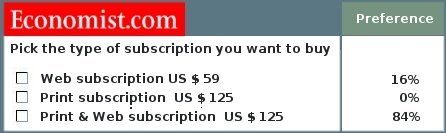
Ariely tested the next ad on the website of the Economist.com on a group of 100 MIT students:

As expected, most students wanted the combo deal (84%). Students can read, so nobody wanted the middle option.

But now, if you have an option nobody wants, you can take it off. Right? So Ariely tested another version of this ad on another group of students, eliminating the middle option. This is what happened:

Now the most popular option (84%) suddenly became the least popular (32%). And the least popular (16%) became the most popular (68%) option.

What happened was that the 'useless' option in the middle, was useless in the sense that nobody wanted it. But it wasn't useless in the sense that it helped people figure out what they wanted. In fact, relative to the option in the middle, which was get only the print for $125, the print and web for $125 looked like a fantastic deal. And as a consequence, people chose it.

The general idea here is that we actually don't know our preferences that well. And because we don't know our preferences that well we're susceptible to all of these influences from the external forces.

Second experiment
People believe that when they see somebody, they immediately know whether they like that person or not. Ariely decided to put this statement to the test.

He showed his students a picture of Tom and a picture of Jerry (real people in practice). Then he asked "Who do you want to date? Tom or Jerry?" But for half the people he added a slightly less attractive (photoshopped) version of Jerry. For the other half of the students he added a slightly less attractive (ugly) version of Tom.

Now the question was, will ugly Jerry and ugly Tom help their respective, more attractive brothers?

The answer was absolutely YES. When ugly Jerry was around, Jerry was popular. When ugly Tom was around, Tom was popular.


Conclusions: The Dummy Effect
What can we conclude from these two experiments?

  • When you let people chose between two options, their decision might be positively influenced by adding a third 'slightly less attractive version' (the dummy) of the option you value as most favorable. So decisions are susceptible to options manipulation.

  • Be aware of the Dummy-Effect when someone adds a dummy option in a choice you'll have to make. If your decision without the dummy is not the same as with the dummy option, try to investigate why. Don't take a decision until you've found out why.

  • Both decisions, with or without dummies, are 'rational'.
    Therefore your 'rational decision' depends more than you're inclined you think on the character, the completeness and the description of the options. Your personal preference becomes more or less irrelevant if the options are incomplete. So think twice about possible 'missing options' before you take a final decision.

From now on...
Now that you've become aware of this dummy-effect, life will never be the same again. You've become conscious of the way the options in a proposal can influence a decision. This gives you the opportunity to take more enriched decisions. It also places you in a more responsible position when you develop proposals for others. Straight proposals will be 'cleaner' than before ('undummied') and also include an explanation about the way a proposal is structured and presented.

Links
- Book Predictably Irrational by Dan Ariely
- MIT Center for future banking


Saturday, April 25, 2009

Job Application Interview

Do you recognize the flabbergasted feeling that occurs when, after a 'splendid' job interview, you come home with a positive feeling and the day after you are rejected?

Although you thought you performed well in the interview, somewhere, somehow, you missed the boat.

What went wrong?

Well, apart from the general pitfalls in a job interview and the trivial explanations of a rejection, most probably things went wrong due to lack of proper communication.

Probably, when you're having an interview, you'll take notes.
Because you're focused on getting the job, you're inclined to (only) write down the positive aspects of the job and the conversation.

This will definitely give you a biased view on the outcome of the interview. You simply miss or underestimate the minor or negative remarks in the interview.

How to solve this?


This is what you can do to get a more realistic idea about the outcome of the interview.


  • Listen
    First of all, make sure you listen well.

  • Take Notes
    Be careful not just to write down your personally important or spectacular issues (e.g salary, benefits, car, etc), but especially note (and write down!) small remarks, advices or 'used adjectives' of the interviewer.

  • Split in Negatives and Positives
    Split your note paper in left and right, and put the positive issues (the Positives) on one side and the negative issues (the Negatives) on the other side.

  • Manage the Negatives
    Make sure to write down every single negative issue or negative adjective, no matter how small. Don't ignore these Negatives. By questioning, make sure you understand them right and manage them one by one. If you're not able to get those negatives from the table or to put them in quarantine, they might kill you in the end without you realizing it. So:

    Manage the Negatives instead of counting the Positives

  • Feedback
    At the end of the conversation ask for feedback and check by asking the interviewer to summarize your Positives and Negatives. If any Negatives are left, handle them with care right there.

  • Don't fake
    Don't try to reason away negatives that are clear facts. If that would imply a rejection, be happy, because you are not qualified for this job and therefor wouldn't be happy in this job as well.

Evaluating an interview is not simply balancing Positives with Negatives. Even a single Negative can screw it up.

P/N-Method
Anyway, this Positives/Negatives Method is not only applicable in case of a job interview, but can be used in every "beauty parade", contract negotiation or proposal you try to defend.

Next time, with a positive attitude, keep your 'sixth sense' on the potential Negatives and manage them!